Sponsored Links







International Section
- UEFA Euro History
- UEFA Nations League
- FIFA World Cup History
- FIFA Women's World Cup
- 2012 Olympics
- Home Internationals
Cup History Section
UK Season Galleries
-
Premier & Football League
- 2022-2023
- 2021-2022
- 2020-2021
- 2019-2020
- 2018-2019
-
Scottish Professional Football League
- 2022-2023
- 2021-2022
- 2020-2021
- 2019-2020
- 2018-2019
- Previous Seasons>>>
- NIFL Premiership
- FA Women's Super League
Cymru Premier
Other Leagues
Articles
- The History of Football Kits UPDATED
- Eminent Victorians
- Room 101 - The Worst Kits of All Time
- Influential & Classic Kits
- Strange Hues - Colourful Favourites
- Iconic Away Kits
- Historical Football Kits in Print
External Links




















The Definitive English and Scottish Football Kit Archive
The material on this site is copyright © Historical Football Kits, all rights reserved. Club crests and sponsors' logos are the intellectual property of their respective owners. For more details visit Copyright Information.
Please note that I have now officially retired and will no longer be updating this website. The site will remain in place for visitors.
Latest News & Updates
Exclusive offer for HFK visitors! Enter the code 10OFFHFK at the checkout to enjoy a 10% discount on all TOFFS products.
20 July
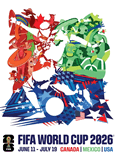 So there we are then. After 104 matches, 308 goals, 6.8 million spectators, $13 billion in revenue (£9.62 billion) and $671 million in prize money awarded (£496 million), Spain are World Champions for the second time and deservedly so. This was a final in which only one team was prepared to play football and sad as it was to witness Messi impotent in
  what wil surely be his last appearance in an Argentinian jersey, it would have been a travesty if his side had somehow stolen the game.
One of my favourite moments was watching the Donald gatecrashing Spain's celebrations after the presenation and being ushered from the podium by his best buddy, Gianni "Today I Feel Like an Idiot" Infantino.
Photo Credit: Yahoo Sports
 So that's more or less it from me and I am now going to retire. There's just one job that I want to finish before I go and that is to complete The History of Football Kits, which should not take long.
It is hard to believe that it is 20 years since Historical Football Kits was launched on the internet. It has been my great pleasure, honour and privilege to have curated the site and the countless thousands of contributions from visitors that transformed what was a personal hobby site into the enormous and comprehensive archive it became. To everyone who has contributed - thank you very much/diolch yn fawr iawn.
17 July
The kit match ups for this weekend's final games have been confirmed and added to the World Cup 2026 section.
While working on the next instalment of the History of Football Kits I realised that many of the modern graphics for Hull City were the wrong shade of amber so I've put that right. Must not allow myself to be distrac...what was that?
15 July
I've added the match report for last night's Semi Final to the World Cup 2026 section and corrected Spain's socks.
Part 10 of The History of Football Kits has been added. This chapter covers the period 2000-2009.
12 July
Match reports for the Quarter Finals have been added to the World Cup 2026 section and the kit match ups for the Semi Finals have now been confirmed.
8 July
The match reports for the Round of 16 are now complete and we now have confirmation of the kits to be worn in the Quarter Finals.
6 July
I've added the match reports for the epic Norway v Brazil and Mexico v England games to the site as well as the remaining kit match ups for the Round of 16.
4 July
I've added the last of the Round of 32 matches as well as the kit match-ups for the Round of 16 that have been released by FIFA so far.
3 July
The matches played overnight in the Round of 32 have been updated and I've also added the missing match report for the New Zealand v Belgium game in Group G.
2 July
So there was another short hiatus over the last couple of days while we travelled back to HFK Towers from Poland but we are now up to date with the latest batch of matches in the Round of 32.
I've corrected the graphic for Japan which showed the wrong socks for the match against Brazil.
I've updated a few more graphics to better reflect the shades we are seeing in the competition rather than in the staged publicity shots released before the competition started. Bosnia & Herzegovina now appear in a darker shade of blue while Senegal's strips now show a lighter shade of "Wild Green."
29 June
We are back on track with all the final group games and the first knock-out match now logged.
At this stage we have had a good look at almost all the kits and their variations. Brazilian Elf and good friend to HFK, Gabriel Vogas has been poring over these and has found several things that had passed me by when I drafted the original graphics. Some of these are so subtle that they are, to misquote Douglas Adams, "Almost, but not quite entirely, unlike black." Here's the list: Brazil (2nd kit now darker), France (2nd now lighter), Uruguay (shorts & trim not black), Netherlands (orange now much deeper than before), Australia (darker shade of green applied, United States (2nd not black).
25 June
We are up to date with the final round of matches in Groups A, B and C. I am also working behind the scenes on what will be my final project which I expect to finish when the World Cup ends. More news in due course.
We are off to Krakow tomorrow for a couple of nights and I don't expect there will be any updates until after we return on Sunday night.
22 June
Groups G & H have been updated.
We now turn to the last of Ian McConnel's valuable Scottish club updates. These are all from 1999-2000.
Heart of Midlothian, St Johnstone, Rangers, Dundee United, East Fife, Kilmarnock, Dundee, Clyde,
21 June
Groups E & F have been updated.
In addition to the 1998-99 Scottish update from Ian McConnel that I published yesterday were two intriguing photographs. The first shows Hamilton Academicals wearing red shirts with white sleeves in a Scottish League Cup match against Rangers in September 1955. We also have a pre-season group photograph of Aberdeen taken in 1948-49 showing the team wearing a similar strip.
20 June
The latest Group C & D matches have been updated.
With that out of the way I'll tackle Ian McConnel's Scottish amendments which have been sitting in my in-tray for a disgracefully long time. I know, I know but I really don't like drawing 1990s kits. These are all from 1998-99.
Heart of Midlothian, Dundee, St Johnstone, Kilmarnock, Motherwell, Aberdeen, St Mirren, Raith Rovers, Forfar Athletic, Rangers (2nd), Dundee United, Ayr United, Alloa Athletic, Stenhousemuir.
19 June
 I'm going to make a start on my promise to clear my in-tray starting with a revised history of the origins of Motherwell submitted by the club's official historian and based on primary sources. The card on the left shows their original colours.
 Keith Mullally was in touch a while ago and sent me this photograph of a very rare Irish Free State jersey that was given to him by his grandfather before he passed away. I have been able to confirm that this came from the period 1930-1936 when the shamrock crest was reinstated. The fact that it is embroidered in gold came as a surprise but is consistent with the colours of the Irish tricolour flag.
World Cup 1974: logos added to Poland's shirts. 1978 European Cup: FC Brugge corrected. Euro 24 Group A: the shocking truth behind Germany's kit choice against Hungary. (Not that shocking really.)
Yeovil Town (socks confirmed mid 1930s).
Photo Credit: Facebook, Keth Mullally
18 June
Yesterday my wonderful Polish wife managed to install an app on my ancient MacBook that allowed me to watch the England-Croatia game live on Polish TV and what a thriller that was! Perhaps because the commentary was in Polish I found it less distracting than some of the drivel that gets served up in the UK. Anyway that wraps it up for the first round of group matches, which are all now updated in the 2026 World Cup section.
I'll get cracking on the second round tomorrow.
16 June
The latest matches in Group F, G & H. have been updated in the 2026 World Cup section.
15 June
There has been a short hiatus in my World Cup updates owing to moving operations to our studio complex in south-western Poland over the week-end. It has to be said that, following Poland's elimination by Sweden in the final  seconds of the European play-off final, interest in the tournament here is less than indifferent.
In the meantime FIFA's kit police have been busy instructing African teams to remove stars from their badges that represent Africa Cup of Nations wins on the grounds that these are not FIFA competitions. In addition they have ordered Egypt to change their shirt font from gold to white to make numbers and names easier for referees to see.
The section is now up to date as of 1400 BST today. More updates will be posted tomorrow.
12 June
 And we're off! The bloated 2026 World Cup finally got underway in one of the world's most iconic stadiums. Over the next five weeks I'll be updating the match-by-match sections regularly.
One item of kit news that emerged one the eve of the competition is that FIFA's kit police have belatedly taken against Haiti's jerseys deeming the graphic breached regulations on political imagery.
Photo credit: The Guardian (Rodrigo Oropeza/AFP/Getty Images)
6 June
 It was twenty years ago today that the Historical Kits website was launched! At the time it was just a personal hobby project that I was persuaded to post on line, hosted on a server run by a friend of my son. Interest grew rapidly and after it was featured in The Guardian, we had so many visitors that the server broke and we realised we would need to pay for a professional hosting service.
From the beginning I wanted to invite visitors to contribute to the development of the site and very quickly contributions began to flood in from enthusiasts, kit anoraks, official and unofficial historians and veterans who shared early memories of being taken to matches as a child. Over time it became my pleasure and privilege to curate thousands of contributions from the growing army of enthusiastic visitors which at its peak numbered over a million a year. It was my greatest pleasure to uncover previously unrecorded kits from the Victorian period and to debunk long-held myths that passed into prosperity because lazy writers were content to repeat what they found in earlier histories rather than check original sources. Their contributions are noted in the list of sources at the foot of each club page.
It has been wonderful to hear from individuals who have been inspired to launch their own projects by visiting HFK and often these have included graphics of a far higher quality than my own. Several recent emails came from young people who were not born when HFK launched but wanted to share how their abiding interest in the history of football kits began when they encountered HFK.
As the anniversary approached I cast around for something to mark the occasion and realised that the forthcoming 2026 World Cup would be an opportunity to undertake one final, big project. I'm pleased to announce that, following the publication of FIFA's official kit guide to the group stages that I have now populated the group stage on the 2026 World Cup section. This includes all the variations that FIFA's kit police have insisted on to satisfy their requirement for high contrast strips on matchdays.
The World Cup also provides a suitable opportunity for me to retire and that is what I intend to do when the tournament is over. There are, however still some contributions in my in-tray and to honour those contributors I shall post these before I hang up my keyboard.
My retirement does not mean the end of the HFK website. I am taking steps to ensure that the site will continue to be available in the future even if it will no longer be updated.
To everyone who has contributed, criticised or appreciated the website over the last two decades I should like to say a very warm and humble "Thank You Very Much."
28 May
Latest additions to the 2026 World Cup section include Uzbekistan (1st, 2nd added), Norway (2nd corrected, 3rd added), Canada (3rd added), Ecuador (3rd added), Jordan (1st, 2nd & 3rd kits updated), Tunisia (1st, 2nd & 3rd kits updated). I am grateful to Jude Clarke who drew these to my attention.
25 May
Curacao (1st), Bosnia & Herzegovina (1st, 2nd), Iraq (1st, 2nd, 3rd) kits added to the 2026 World Cup section. That leaves Uzbekistan as the only nation yet to announce their World Cup kits.
15 May
I've added Mexico's 3rd kit and Iran's 1st and 2nd kits to the 2026 World Cup section.
6 May
I've added Group L to the 2026 World Cup section. I'll add the missing kits when these are announced but in the meantime I'm going back to building our new shed.
5 May
Group J and K have been added to the 2026 World Cup section although Uzbekistan have not announced their kits yet. I'll try to complete the final group over the next couple of days before building the match-by-match sections so they are ready for the tournament to kick off.
 As we would expect, the big three sportswear providers are sponsoring the lion's share of teams with 37 of the participants signed up to Adidas (14), Nike (12) and Puma (11). Other suppliers are well represented
  with 8 teams on their rosters while 3 federations are undeclared.
I rather like Adidas' Tiro 26 Competition design with its thicker trim but I am mystified by their decision to have different templates for teams' second kits, with narrow three-stripe trim, retro trefoil logos and different number fonts. It's almost as if we now have two Adidas companies with different creative visions.
 Nike's new template has received attention for all the wrong reasons because of the shoulder seam that won't lie flat. Apparently Nike are advising buyers to wash their new shirt before wearing it but if I had shelled out £125 for the Authentic version of my team's shirt I'd expect it to be perfect out of the box. The
  flowing seams and panels are somewhat understated allowing the viewer to focus on the creative design work that has gone into some of these jerseys.
Puma's new template is very disappointing not least because the patches on the sides of the jersey look different or even disappear depending on the position and pose of the player. While Adidas' templates and those of Nike  look like they are integral to the overall concept, these Puma patches seem like an afterthought that doesn't contribute to the overall design.
I want to mention the kits that Colombian supplier Saeta have provided to Haiti.  These are in an identical template with a remarkable detail in the lower right hand side of the jersey where the heroes of the Haitian revolution raise the flag of freedom in 1804.
Which brings us neatly to how designers have sought to integrate national cultural ideas into their work and here there is much to enjoy. Puma have, for example, incorporated into Egypt's red shirt an image of the Great Pyramid exuding waves of pharaonic energy.
 It is, however, the second choice jerseys that have afforded designers the chance to let their imaginations rip. Freed from the constraints of working with
  restricted colour palettes and patterns, they have been given free reign to exercise their creativity. Adidas have, for example, drawn on Belgium's surrealist art movement (think Magritte) for their change shirt. Playfully, written into the back of the collar is Ceci n'est pas un maillot (this is not a jersey).
Nike have come up with a dark navy strip with a radiating electric blue graphic for Uruguay that some thought was inspired by a character from the Marvel Universe. In fact  the pattern was inspired by the sweeping stands of the Estadio Centenario where Uruguay won the inaugural World Cup in 1930.
Portugal's strips celebrate the country's long-standing maritime tradition and this is represented on their change shirt by crashing waves.
Photo Credits: Soccer Bible, Footy Headlines, Football Shirt Culture, Puma.com.
I recently received an email from Jake, who is 16 and has been following HFK for years. He has launched his own World Cup 2026 website on which you can vote to  rank the best kits, read kit-of-the-day posts and team kit pages, download a free wall chart and much more. If you want to invest more time looking at World Cup kit trivia take a look.
23 April
Group I teams have been added to the 2026 World Cup section apart from Iraq, who have yet to announce their outfits.
21 April
Group H teams have now been added to the 2026 World Cup section.
17 April
Group G teams have been added to the 2026 World Cup section with the exception of Iran who have yet to confirm if they will participate much less release news about this kits. I have noticed that some "Iran World Cup 2026" jerseys are being sold in online markets but I urge caution before buying as I am pretty sure they are fakes.
14 April
Group F teams have been added to the 2026 World Cup section.
 I have been very amused by stories that have emerged since the last international break about the design flaw in Nike's latest hi-tech jerseys that can cause the shoulder seam to bunch up in a very odd manner. Nike have admitted there is a problem and say they are urgently looking into finding a solution. It's pleasing to know that the global giants of sports leisurewear can cock things up just like the rest of us.
Spoiler Alert!! If you've been following the BBC's excellent 2026 mockumentary you may be under the impression that the Oversight Team's Director of Integrity, Ian Fletcher has resigned to join the 2028 Olympics team. I think it's more likely that he has been tapped by Nike to help them spin their way out of this hole.
Photo Credit: THe Guardian, Nigel French/Getty Images/Allstar)
11 April
The Group E teams have been added to the 2026 World Cup section.
10 April
Several visitors have asked me if I plan to cover the 2026 World Cup this year. I've been reluctant to commit myself to this given the size of the project and how the complexity of modern kits makes drawing them very time consuming. On the other hand I do enjoy a challenge and since June will be a special landmark for the website it seems appropriate to mark this with a major project.
So I am pleased to announce that I shall indeed be covering the 2026 World Cup. This is being launched as a work in progress and I hope to complete the index page by the end of the month. After that I shall create the sections for match-by-match coverage. The first four groups have been completed and I'll provide regular updates here and you are of course very welcome to visit the new section as I build it.
Since I am no longer active on social media I would be most grateful if visitors would share the word through their own networks to spread the good news.
And I promise not to mention Donald Trump (damn!).
4 March
 I am very grateful to Michael West of the Yeovil Town Heritage Society for sharing the fruits of his research into the history of Yeovil Town's kits. As a result I have updated the Glovers' section with nine previously unrecorded kits, several corrections and revised dates between 1895 and 1975. The photograph shows the Yeovil team from 1908-09 with the Dorset League champions trophy.
 Photo credit: Bygone Yeovil Facebook
Barnet (1972-75 added), Maidstone United (1981-82 added), Bury (1981-82 missing tape added to shirt).
This photograph is of the Barnet team of 1972-73, complete with excessive face furniture and kipper ties. Those were the days.
2 March
My sincere apologies for the total lack of activity on the site for the past several months. This was due to a bout of poor health in December followed by a truly memorable holiday in West Africa in January. As a result I'm afraid I rather lost my motivation but as Spring approaches I shall once more pick up the reins (does a website have reins?) and resume updating.
I'll start by working through some of the items that have been sitting in my in tray.
 Newcastle United's official historian, Paul Joannou, wrote in his programme notes a while ago that when the team joined the Second Division in the 1893-94 season no fewer than seven of the 15 teams in that division wore red. When the team travelled to Woolwich Arsenal for their opening match, the visitors wore blue and white striped shirts as shown here. These served as an alternative for the rest of the season but the requirement to change frequently prompted the committee to adopt black and white stripes for the following season with dark blue knickers. And the rest is history.
Photo credit: chroniclelive.co.uk
Robin Horton has found these snippets in contemporary press reports: Burnley (red socks worn in 1890-91), Middlesbrough (wore white shirts and navy knickers until 1901 when their red change jerseys became first choice).
 I'm grateful to John Bremner who found this photograph of Rangers lining up at Nou Camp to
  play Barcelona during their May 1956 tour of Spain. This gives us an excellent view of the large "R" worn on the players' shirts. Contrary to expectation this is not rendered in a conventional font but a rather unusual rope like design. It has been suggested that these tops were borrowed from a local team and this feature lends some credence to this idea. While researcing this image I also came across a photograph taken in November 1956 when Rangers met OGC Nice in a European Cup First Round play-off. Once again a crest is in evidence and while it is difficult to make it out from the grainy image it does appear to be a version of the familiar RFC monogram but with considerably fatter lettering.
Photo credit: The Rangers Archive