

Kit History
West End
Formed 1882
Wound up 1892

1882-1885 P
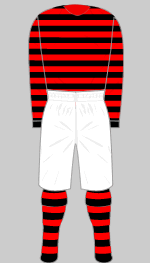
c1885-c1887 a z P
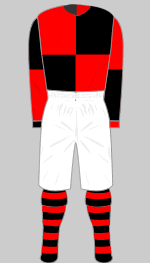
c1885-c1887 alt z
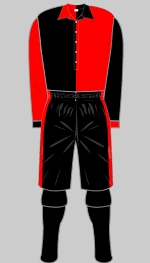
1887-1890 x y z
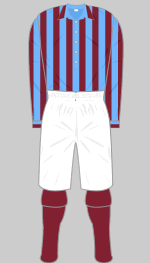
1890-1891 z K P
1891-1892 P
Stanley
Formed 1881
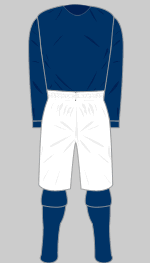
1881-1883 P
East End
1882
Formerly Stanley
1882-1885 z H P
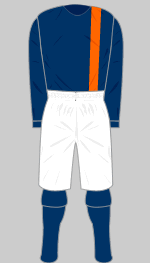
1885-1890 z
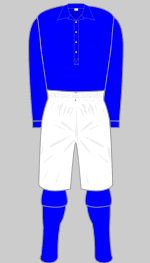
1890-1891 z D K P
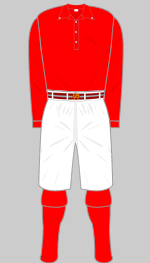
1891-1892 a l z P
Newcastle United
1892
Formerly East End
1892-1894 a y z
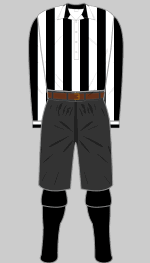
1894-1897 a f v D
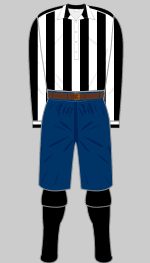
1897-1900 a h v D
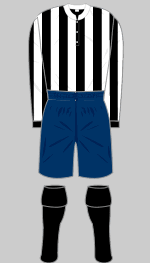
1900-1902 3t D P
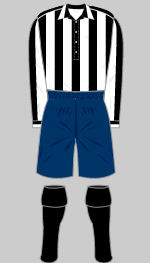
1903-1904 v D P
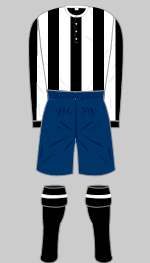
1904-1906 v D
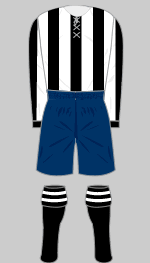
1906-1909 v D
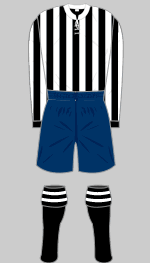
1909-1910 D P
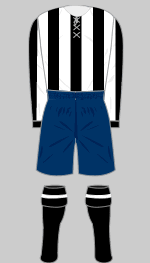
1910-1911 d u v D
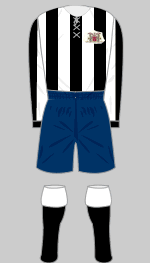
1910 FA Cup Final N
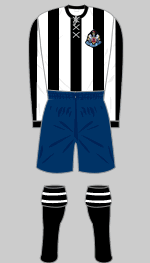
1911 FA Cup Final

1911-1912 P

1912-1913 p
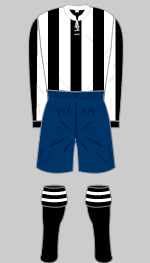
1913-1915 u I P
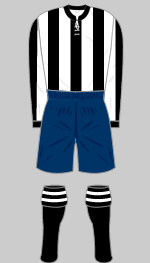
1919-1922 o P
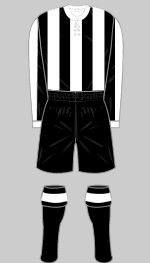
1922-1930 c j v D P
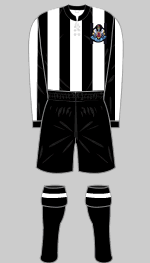
1924 FA Cup Final

1927 Special P Q

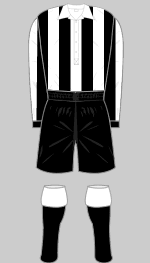
1930-1931 v B P
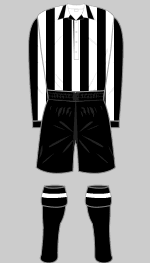
1931-1936 v P
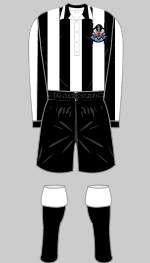
1932 FA Cup Final
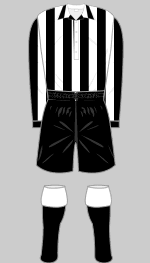
1936-1958 c m v D P
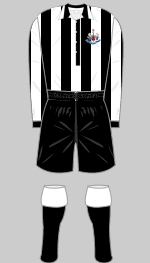
51 52 FA Cup Finals
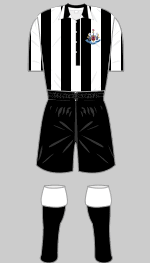
1955 FA Cup Final
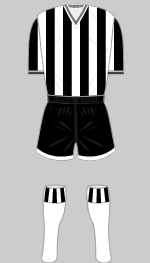
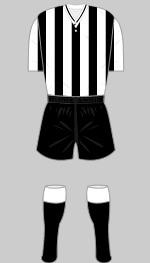
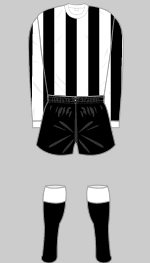
1963-1964 1 g D
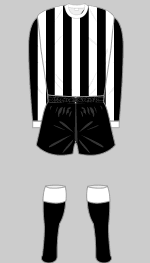
1963-1965 v D P
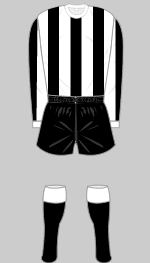
1965-1966 v D P
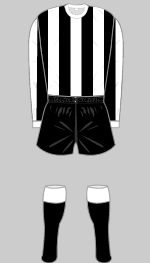
1966-1967 D J P
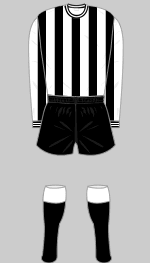
1967-1970 a P
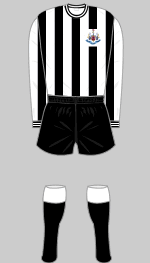
1969 Fairs Cup
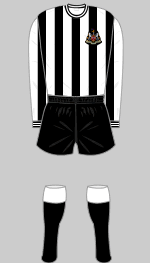
1970-1973 i D P
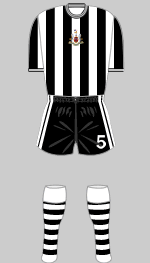
Aug-Sept 1973 M
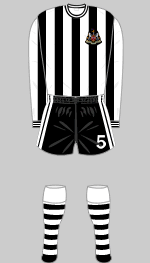
Oct 73-Feb 74 M
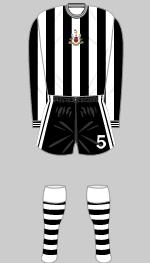
Feb-May 74 b s v F L
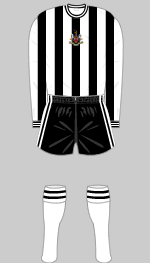
1974-1975 b

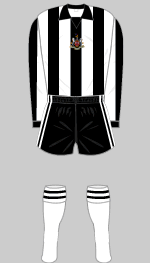
1975-1976 b
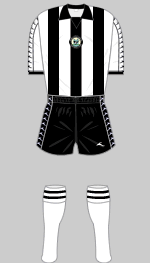
1976-1978 b C D E
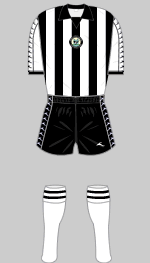
1978-1980 C
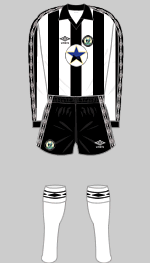
1980-1981 p
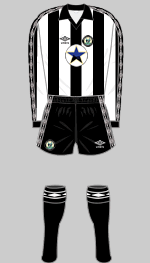
1981-1982 G
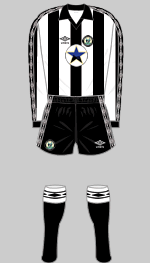
Aug-Oct 1982 b e p
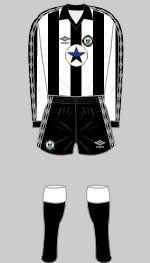
Oct 1982-1983 G
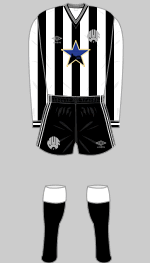
1983-1985 b e x
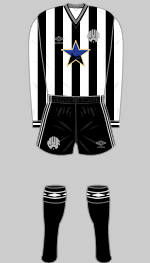
1985-1986 b e x
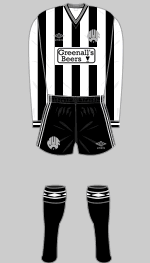
1986-1987 1 b e x
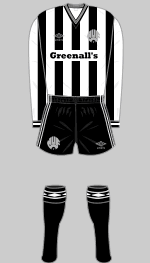
1986-1987 2 b e x
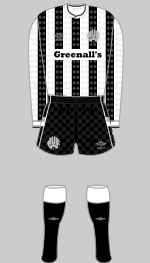
1987-1988 b e
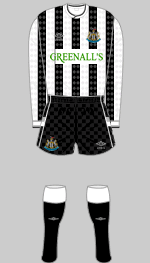
1988-1989 1 b e C
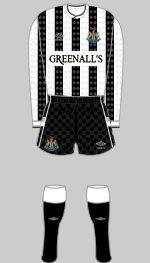
1988-1989-2 b e C
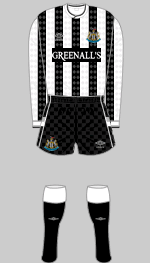
1989-1990 b e
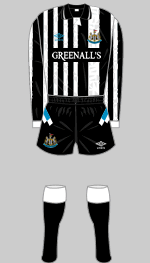
1990-1991 b e n x
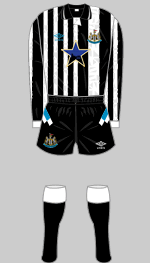
1991-1993 1 b e h x
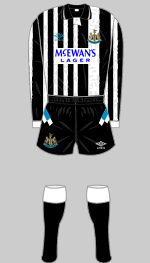
1991-1993 2 e
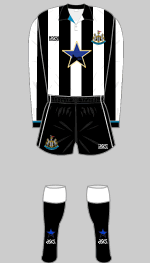
1993-1995 1 b e q
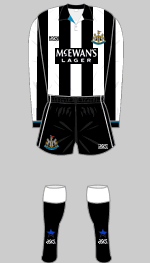
1993-1995 2 b e q
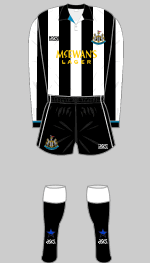
1993-1995 3 b e q
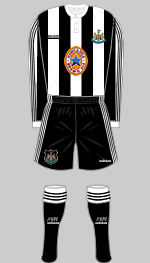
1995-1997 b w A
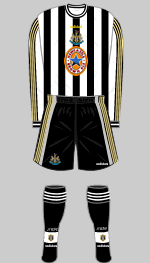
1997-1999 b e w

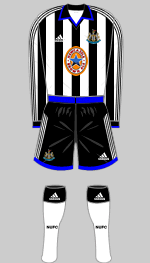
1999-2000 b e w
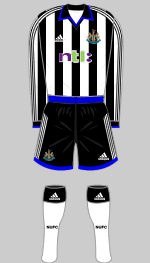
2000-2001 e
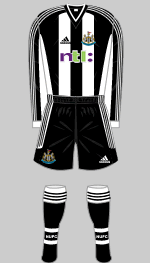
2001-2003 b
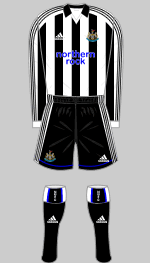
2003-2005 a
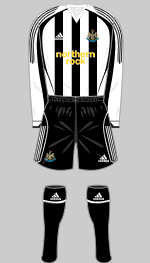
2005-2007 a
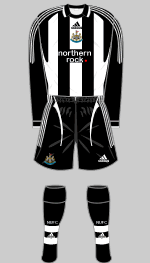
2007-2009 a
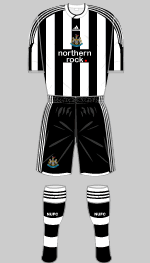
2009-2010 a
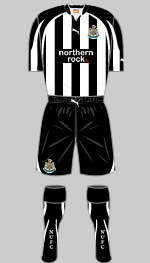
2010-2011 a
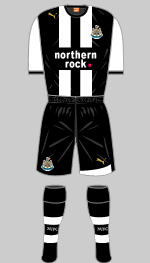
Aug-Dec 2011 a
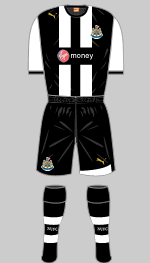
Jan-May 2012 a
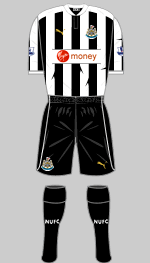
2012-2013 a
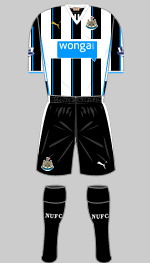
2013-2014 a
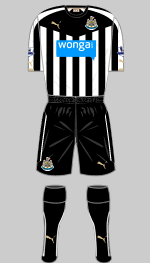
2014-2015 a
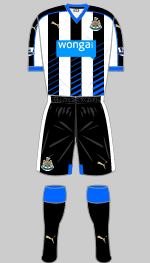
2015-2016 a
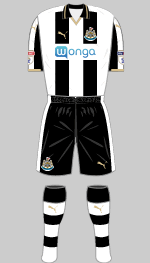
2016-2017 a
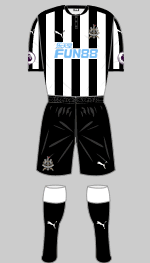
2017-2018 a
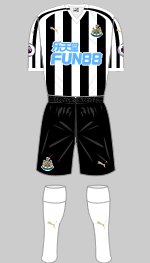
2018-2019 a
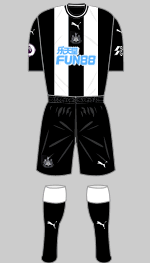
2019-2020 a
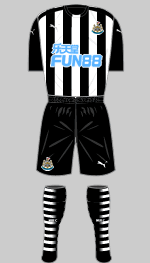
2020-2021 a

2021-2022 a
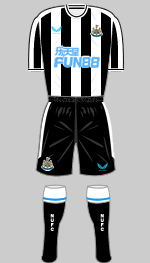
2022-2023 a

2023-2024 * a

2024-2025 * a
Background
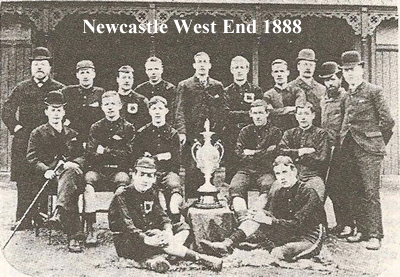 Historically it was widely held that Newcastle United came into being as the result of a merger between the city's two professional teams. Joannou & Candlish's Pioneers of the North (2009) reveals a rather more complicated story.
During the 1880s two football clubs emerged as offshoots of cricket clubs in Newcastle and gradually became pre-eminent in the city. West End FC (formed in 1882) originally played on a pitch in an area called Newcastle Leazes, part of the Town Moor common and they wore blue jerseys until 1885 when they adopted red and black colours. Joannou and Candlish confirm that both hooped and "quartered" versions were worn contemporaneously. Like most teams of the period, attitudes to team colours were fairly relaxed and photographs reveal some variations in the width of hoops, embellishments to jerseys (one player had "WEFC" embroidered across his chest while others sported the Northumberland FA crest) and various stockings. During the summer of 1885 football was banned on Town Moor so West End moved to Moor Edge in Jesmond, a ground they shared with Newcastle Association. In May 1886, West End relocated to St James Park on Gallowgate, which had been previously occupied by the now defunct Rangers FC.
In 1887-88 the team wore halved shirts with dark (probably black) knickers and won the Norhumberland Senior Cup. For the 1890-91 season the team played in marron and light blue striped shirts and dark blue kniclers before reverting to red and black for what would prove to be their final season.
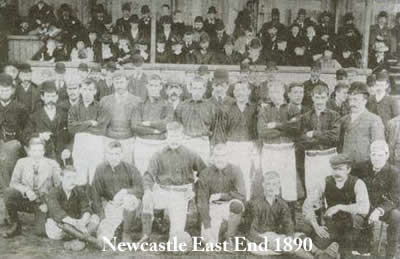 West End's great rivals were formed as Stanley FC a little earlier in November 1881 and played in the Byker district of the city. They became East End FC in October 1882 to avoid confusion with Stanley FC from the town of that name in County Durham who were affiliated to the Northumberland & Durham FA. Shortly afterwards they absorbed Rosewood FC who henceforward would play as the East End Second XI. The club was further strengthened in 1887 when they absorbed Cheviot FC and Union Harriers.
During the 1880s the East and West End clubs gradually eclipsed the older clubs in the city, Rangers and Tyne Association. By the end of the decade they regularly hosted friendly matches against the leading English and Scottish sides and in 1889 both turned fully professional and were importing players from Scotland in increasing numbers. Both sides competed in the Northern League but neither was strong enough to win the championship.
In the early 1890s it became apparent that the city could not support two professional teams with ambitions to play in the Football League. West End had the better ground but attendances were declining and the team were performing poorly whereas East End, with an inferior ground had the stronger team. The crunch came in May 1892 when, after the team managed just one win in their Northern League campaign, the directors of West End announced the club would be wound up. In a final act of considerable foresight, the principal directors of the club offered their rivals the pick of their playing staff and other assets including the lease on St James' Park.
East End's application to join the Football League that month attracted just one vote but they were invited to join the newly formed Second Division. This they declined because it seemed unlikely that playing at a lower level nationally would compensate for the considerably increased travel costs they would incur. The committee now turned their attention to broadening the appeal of the club to the supporters of both East and West End teams and at a meeting on 9 December 1892, a new title of Newcastle United was created. Curiously, although the new name was recognised by the FA, it was not until 1895 that Newcastle United was legally constituted.
In 1893 United were elected to one of the the four vacancies created by the expansion of Division Two. No fewer than seven other teams in the division also wore red. The frequent changes prompted the committee to adopt the now famous black and white stripes for the 1894-95 season.
In 1898, Newcastle contested the test matches to decide promotion and relegation but missed out in the mini-league competition. Following allegations that the test match between Burnley and Stoke had been fixed, it was decided to expand the League with four additional places. Newcastle and Blackburn were voted into Division One (rendering the test matches meaningless). Promotion and relegation issues after this were decided automatically until the introduction of play-offs in the 1990s.
 The Edwardian period proved to be Newcastle's golden
age. With a squad dominated by talented Scots, United won three League
Championships (1905, 1907, 1909) and reached five FA Cup Finals (1905,
1906,
The Edwardian period proved to be Newcastle's golden
age. With a squad dominated by talented Scots, United won three League
Championships (1905, 1907, 1909) and reached five FA Cup Finals (1905,
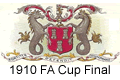
1906, 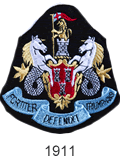 1908, 1910 and 1911) but won only once, in 1910. The city's coat of arms appeared on the team's shirts for the first time in the 1910 final. A slightly different version was worn in the final a year later and this appeared in every Cup Final United played in but did not appear in Football League matches until 1969-70.
 After the Great War, "The
Magpies" won the FA Cup again in 1924 and three years later were
League Champions for the fourth time (1927). Several shirts survive from this campaign with a commemorative badge stitched on. There is, however, no evidence that these badges appeared in any competive game and the most likely explanation is that the club presented the championship winning team with the badges and several players had them stitched to their shirts as souvenirs. One such example fetched £6000 when sold at auction in 2025.
After the Great War, "The
Magpies" won the FA Cup again in 1924 and three years later were
League Champions for the fourth time (1927). Several shirts survive from this campaign with a commemorative badge stitched on. There is, however, no evidence that these badges appeared in any competive game and the most likely explanation is that the club presented the championship winning team with the badges and several players had them stitched to their shirts as souvenirs. One such example fetched £6000 when sold at auction in 2025.
In 1932 United beat Arsenal in the FA Cup final with an infamous goal that was later shown to have been scored from a cross after the ball had crossed the goal-line. Two years later the club was relegated to Division Two.
In 1948 United were promoted back to Division One
in front of average home gates of almost 57,000. Within five years the club lifted
the FA Cup three times (1951, 1952, 1955) with teams featuring the Chilean
Robledo brothers, "Wor Jackie" Milburn and Bobby "Dazzler"
Mitchell. This would be, sadly, the last glory that the team 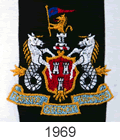 with such
devoted support would achieve for some time. Relegated in 1961, United
returned to Division One in 1965 but continued to be unpredictable.
with such
devoted support would achieve for some time. Relegated in 1961, United
returned to Division One in 1965 but continued to be unpredictable.
 In 1969 Newcastle unexpectedly won the Inter-City
Fairs Cup (forerunner of the UEFA Cup). Following this success, the crest became a permanent feature on the team's shirts. This proved an isolated success,
however. In the 1970s the brash Malcolm "Supermac" Macdonald
proved one of the League's finest goal scorers but appearances in the FA
Cup final (1974) and League Cup final (1976) both ended in defeat despite
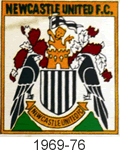
his presence. Curiously a very different crest (right) appeared on official documents, programmes and merchandise but not on the team shirts during this period.
In 1969 Newcastle unexpectedly won the Inter-City
Fairs Cup (forerunner of the UEFA Cup). Following this success, the crest became a permanent feature on the team's shirts. This proved an isolated success,
however. In the 1970s the brash Malcolm "Supermac" Macdonald
proved one of the League's finest goal scorers but appearances in the FA
Cup final (1974) and League Cup final (1976) both ended in defeat despite
his presence. Curiously a very different crest (right) appeared on official documents, programmes and merchandise but not on the team shirts during this period.
In 1976 the club adopted its own crest, which featured a magpie 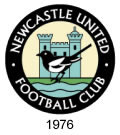 standing in front of a castle and above flowing water, representing the River Tyne. The choice of a roundel rather than a shield was typical of the fashion of the time.
In 1978, the "Toon" were relegated to Division Two and were going nowhere until ex-England skipper Kevin Keegan was persuaded to join the club as captain. A new crest introduced at the start of the 1983-84 season was intended to presage a new period of progress and achievement. A stylised disc made up of the letters NUFC, it was embroidered on to the striped home shirts in silver-grey, making it virtually invisible. Nevertheless, Keegan inspired both players and fans and led the side to promotion in storming style in 1984.
The new style crest was not particularly popular and in 1988 it was replaced by a more traditional but streamlined design that borrowed several elements from the city coat of arms, such as the supporters (a pair of sea-horses) while  the cross of St George appears on a blue pennant rather than a white one (possibly to avoid any suggestion of the colours of the team's greatest rivals, Sunderland.) The centre-piece is a shield in the club's famous stripes. This elegant design has proved both popular and durable and served unchanged for over 20 years.
When Keegan retired the club was wracked by board room struggles that ultimately saw Toon relegated again in 1989. With money drying up, star players such as Paul Gascoigne were sold off and support dwindled. In 1992, United were struggling to fend off relegation to Division Three and losing up to £700,000 a year in interest charges alone when Sir John Hall took control and appointed Kevin Keegan, out of football since he retired as a player in 1984, as manager.
Relegation was avoided and over the following seasons Hall invested millions to transform St James' Park and introduce quality players while Keegan inspired his players. Promoted to the Premiership as champions of Nationwide Division One in 1993, the Toon became serious contenders for the Premiership title and qualified for the Champions' League for the first time. In 1996 Newcastle paid a record £15m to bring Alan Shearer, a native Geordie and acknowledged as the finest centre-forward in Europe, to the club. In January Keegan decided to walk away rather than deal with the pressure of management at this level, a move that stunned everyone associated with the club. Keegan's place was taken by first Kenny Dalglish and then Ruud Gullitt, both of whom proved disastrous.
In 1999 the highly respected Bobby Robson returned to his native city to take over as manager. He stabilised the club and led them back into regular European Champions League competition. After a row in 2004, Robson was controversially replaced with Graeme Souness. Newcastle were transformed into serious contenders for domestic and European honours but have so far failed to deliver, despite the devoted support of the Toon Army of supporters that regularly fills their ground. The signing of Michael Owen in 2005 added yet another hero to United's tradition of great centre-forwards but the back room struggles and mismanagement that have dogged this famous club intensified. In May 2007 the club's owners, the Hall family and chairman, Freddy Shepherd sold theeir majority shareholding to Mike Ashley, a previously reclusive entrepreneur who took to sitting with fans in the stands rather than the directors' box. Ashley brought Kevin Keegan back as manager, a coup greeted with enthusiasm by the Toon Army but his decision to create a "continental management structure" that included Denis Wise as Executive Director (Football) as well as executives with responsibility for player recruitment, "technical co-ordination" and "operations" resulted in chaos. Keegan resigned after 232 days leading to vociferous demonstrations by supporters against Ashley and the board.
Ashley announced that he was putting the club up for sale and appointed Joe Kinnear as interim manager. When no buyer came forward, Ashley announced his intention to stay with the club and appoint Kinnear as permanent manager but ill-health forced Kinnear to withdraw. On 1 April 2009, with the team struggling near the foot of the table, Alan Shearer agreed to become interim-manager while Denis Wise departed a few days later. It was, however, far too late and Shearer was unable to save the club from relegation.
The following season, after Ashley failed to find a buyer, Chris Hughton was confirmed as manager and rallied the team who ran away with the Championship to bounce back immediately to the Premier League.
On 1 January 2012, Virgin Money formally acquired Northern Rock from HM Government (the bank had been nationalised in 2008 at the beginning of the global financial crisis) and their logo was introduced onto the team's shirts. After an outstanding season under new boss Alan Pardew, Toon won a place in the Europa League, the first time they had qualified for Europe since 2004.
 Geordie fans became increasingly disillusioned with Mike Ashley's regime and the cynical way in which the club was turned into a vehicle for generating cash rather than competing for silverware. The club recorded £18.7m profit in 2013-14 and had an additional £34m sitting in the bank while many staff worked on zero-hours contracts for the minimum wage (a business model imported from Ashley's Sports Direct company). A depleted squad of budget imports (only seven members of the first-team squad were British) plunged from a safe mid-table position into the relegation zone in 2015-16 and wound up in the Championship.
 In a tense race with Brighton, Newcastle won the Championship title on the last day of the following season to return to the Premier League for their 125th anniversary season since they changed their name to Newcastle United.
The 2019-20 season marked the fiftieth anniversary of Newcastle winning the Inter-City Fairs Cup, the last major trophy won by the team. The kit introduced to mark the occasion featured a rather nice monochromatic crest.
In April 2020 Mike Ashley struck a deal with a consortium fronted by Amanda Staveley (who had brokered the sale of Manchester City to the Abu Dhabi United group in 2008) for a reported £300 million subject to approval from the Premier League. The majority shareholder would, it emerged be Saudi Arabia's sovereign wealth fund, PIF, who would acquire 80% of the club. PIF was headed by Crown Prince Mohammed bin Salman who was widely believed to have approved the assassination of journalist Jamal Khassoggi in 2018 as well as the detention and torture of dissidents within the kingdom. Another issue that was of concern to the Premier League was the failure of the Saudi authorities to stop the TV network, beoutQ broadcasting Premier League matches within Saudi Arabia in breach of international piracy laws and causing substantial losses to the legal rights holder, beinQ, which was banned from broadcasting in Saudi Arabia. The Premier League's investigations dragged on into July amid a growing outcry (at least outside of Newcastle) and on 30 July the consortium announced that it had withdrawn its bid.
Newcastle supporters were outraged and called for a government investigation into the Premier League's handling of the takeover and allegations that the Owners & Directors' Test had been deliberately misapplied in order to block the deal. The club launched two legal arbitration actions challenging the Premier League's view that the Saudi government and PIF were not separate entities and that the Premier League had acted anti-competitively. After many delays, the jurisdiction hearing for the UK Competition Appeal Tribunal (CAT) was held on 29 September 2021. Before the tribunal could decide if the case should proceed, the Saudi government lifted its ban on beinQ, removing the barrier that had most concerned the Premier League. It was reported that a compromise had been reached that would allow the takeover to go ahead some 18 months after the original bid was put forward. Disquiet among Premier League clubs at the prospect of another member club having access to essentially unlimited funds led to a change in the rules to prevent Newcastle striking high value sponsorship deals with Saudi companies.
With Eddie Howe in charge of the team and £241m spent on the transfer market, Toon finished fourth and reached the Carabao cup final in 2022-23. Having qualified for the Champions League they were eliminated in the group stage. In March 2025, the Magpies beat Liverpool 2-1 in the final of the EFL (Carabao) Cup, their first trophy since 1969 and their first domestic trophy in 70 years.
Sources
- (*) Graphic by Daniel Stoker
- (a) Newcastle United Official Website
- (b) Sporting Heroes
- (c) Football Focus
- (d) Nineteen66 Rare Football Memorabilia
- (e) True Colours (John Devlin 2005)
- (f) Association of Football Statisticians - provided by Pete Wyatt
- (g) Pete's Picture Palace
- (h) David King
- (i) Football League Review provided by Simon Monks
- (j) Toffs
- (k) Arthur Willis
- (l) spartacus.schoolnet
- (m) Scunthorpe United - A Pictorial History (John Staff 2007)
- (n) Paul from footballnotmuggybonehead.com
- (o) Simon Monks
- (p) Ralph Pomeroy
- (q) Craig Hayton
- (r) Rod49
- (s) Steve Oliver
- (t) British Film Institute Archive (Youtube)
- (u) The Lord Price Collection
- (v) Keith Ellis (HFK Research Associate)
- (w) Matthew Koziol
- (x) Christopher Worrall
- (y) Paul Brown
- (z) Pioneers of the North (Paul Joannou & Alan Candlish 2009)
- (A) Cal Sear
- (B) Ian Lambert
- (C) Gavin Haigh
- (D) Jonathan Auty
- (E) Andy Fisher
- (F) Andy Gray
- (G) Mark Valentine
- (H) Lost Teams of the North (Mike Bradbury 2016)
- (I) Football & the First World War
- (J) John Duns
- (K) Charles Alcock's Football Annuals 1868-1891 researched by Robin Horton
- (L) Black & White Stripes (Gavin Haigh) submitted by Jonathon Auty
- (M) Tony Sealey
- (N) Ed Bartlett
- (O) Meisterdrucke
- (P) Paul Joannou
- (Q) Graham Budd Auctions
Crests are the property of Newcastle United FC.