


Manchester
City
Formed 1880
Elected to Division Two 1892
Kit History
Gorton
1884-1887
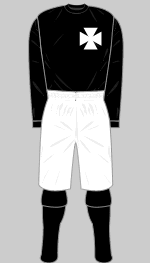
1884 a
Ardwick
1887-1894
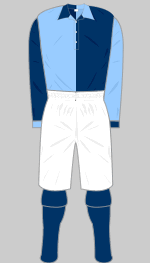
1887 A
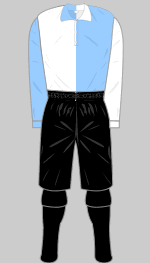
1890-1891 q
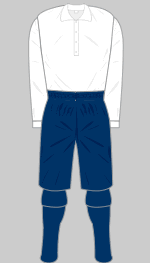
1892-1894 j y
Manchester City
1894
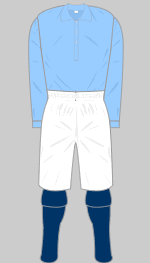
1894-1895 a q
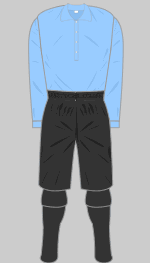
1895-1896 p
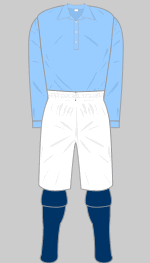
1896-1899 q
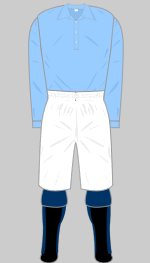
1899-1900 q
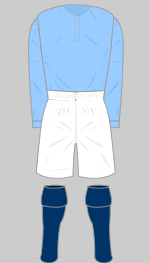
1900-1901 i
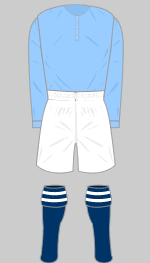
1903-circa1920 a f i
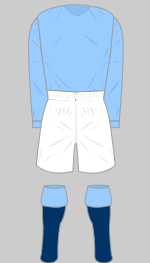
1921-1933 a b c g q

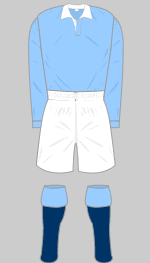
1933-1937 i

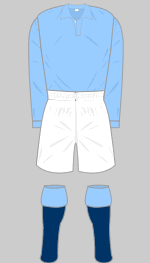
1937-1946 b q
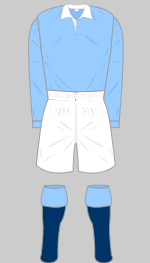
1946-1951 a u
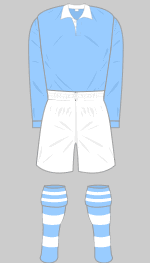
1951-1955 j q s
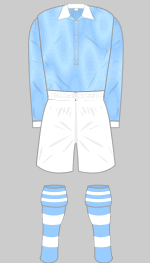
14 October 1953 B
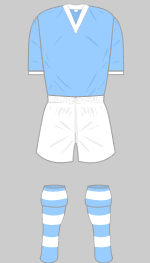
1955-1958 b f q
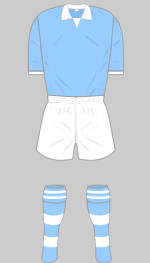
1958-1959 a b q
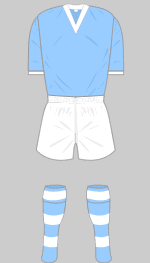
1959-1960 a
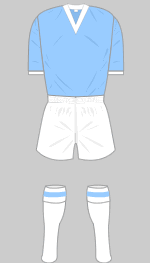
1960-1961 q r
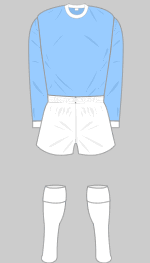
1961-1962 a b k
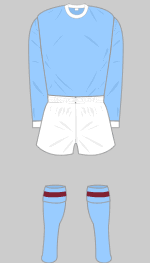
1962-1963 q
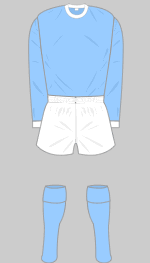
1963-1966 a k q
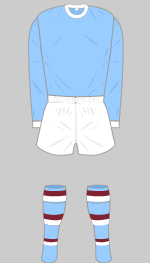
1966-1967
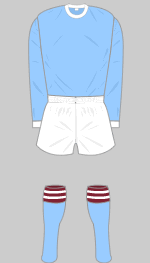
1967-1968 a b f
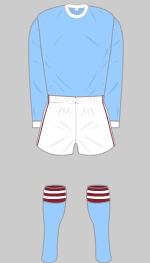
April 1968-1969 a b f
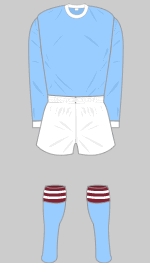
1969-1970 a i l
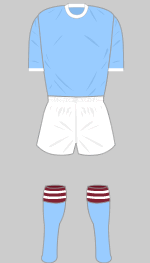
Aug-Oct 1970 C
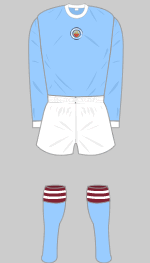
Oct 70-Sept 72 m u x C
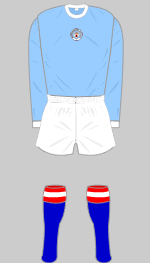
Oct 1972-1974 d m o
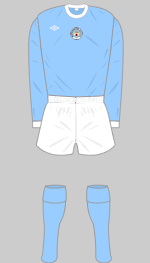
1974-1975 d w
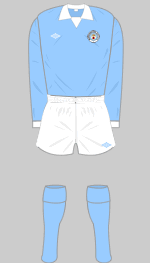
1975-1976 d x
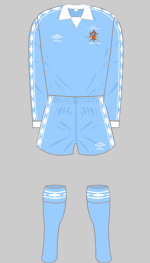
1976-1977 d m

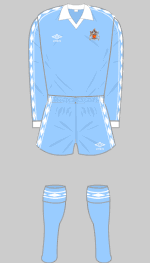
1977-1978 d m
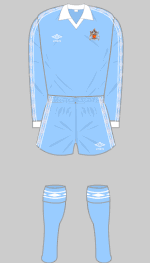
1978-1981 d h
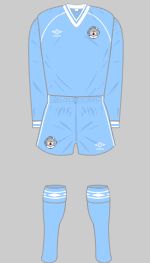
1981-1982 d h
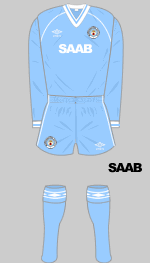
1982-1983 d h k
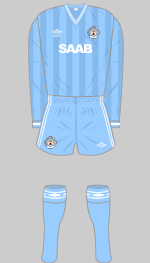
1983-1984 h
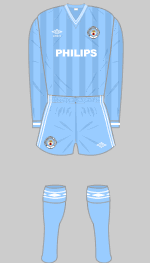
1984-1985 h
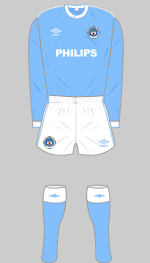
1985-1987 d
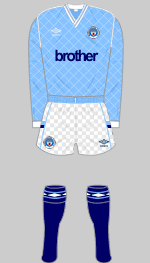
1987-1989 d
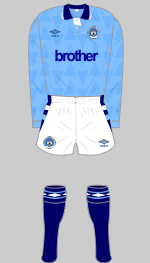
1989-1991 d
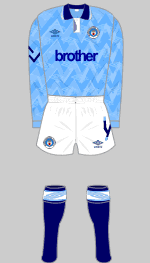
1991-1993 d
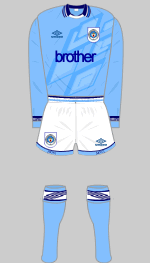
1993-1995 d
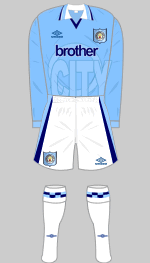
1995-1997 d
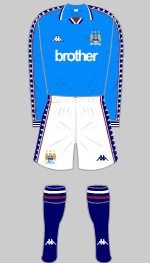
1997-1999 d
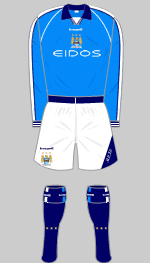
1999-2001 d
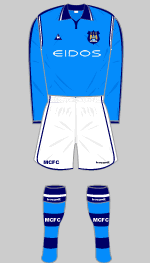
2001-2002 d
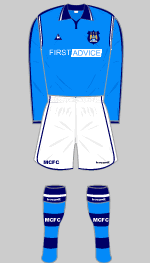
2002-2003 d
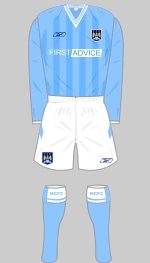
2003-2004 b t

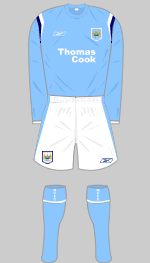
2004-2006 e t
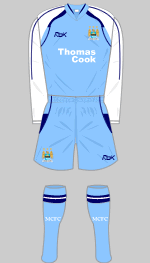
2006-2007 e t
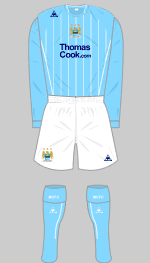
2007-2008 e
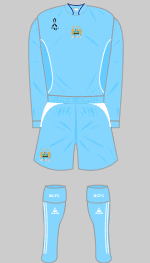
10 Feb 2008
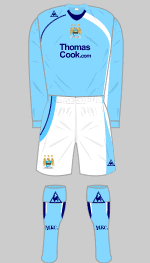
2008-2009 e
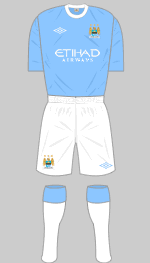
2009-2010 e
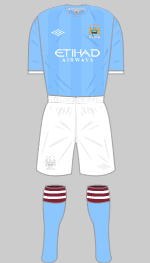
2010-2011 e
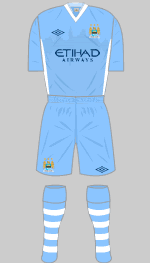
2011-2012 e
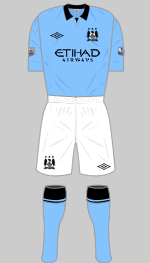
2012-2013 e
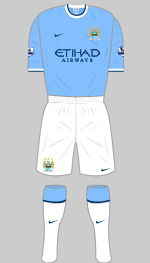
2013-2014 e
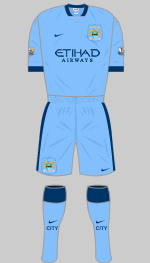
2014-2015 e
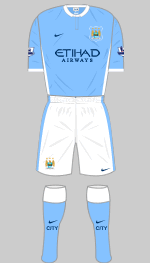
2015-2016 e
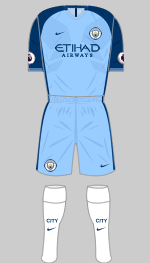
2016-2017 e
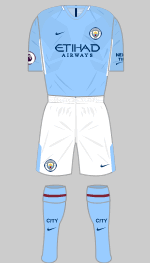
2017-2018 e
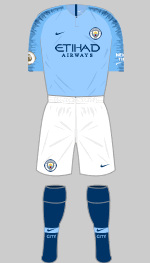
2018-2019 e
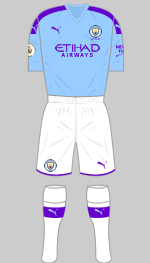
2019-2020 e
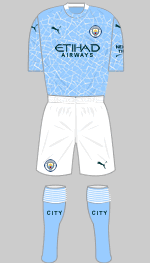
2020-2021 e
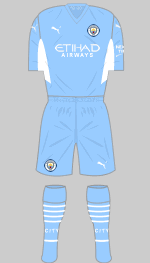
2021-2022 e
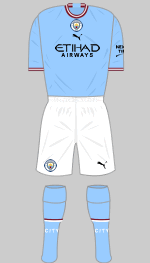
2022-2023 e

2023-2024 e *
Background
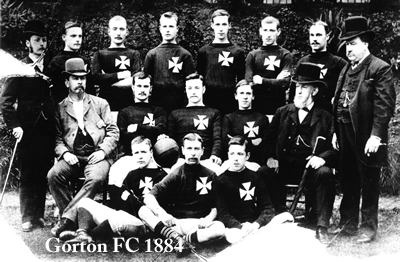 Manchester City are a world
famous club with a devoted fan base. What is less well known is that the
modern club owes its existence to a woman. In
1879 Arthur Connell was appointed curate of St Mark's church in the working
class West Gorton district of Manchester. Like most of the rapidly growing
industrial areas of the north and midlands, West Gorton had no social
facilities apart from public houses. Arthur's young wife, Anna Connell,
decided to form an association to encourage young working men to spend
more of their time on physical pursuits and less of their wages on beer.
Anna persisted in the face of initial indifference and over the summer
the members formed a cricket team, which was so successful that in 1880
the members formed St. Mark's (West Gorton) FC.
Manchester City are a world
famous club with a devoted fan base. What is less well known is that the
modern club owes its existence to a woman. In
1879 Arthur Connell was appointed curate of St Mark's church in the working
class West Gorton district of Manchester. Like most of the rapidly growing
industrial areas of the north and midlands, West Gorton had no social
facilities apart from public houses. Arthur's young wife, Anna Connell,
decided to form an association to encourage young working men to spend
more of their time on physical pursuits and less of their wages on beer.
Anna persisted in the face of initial indifference and over the summer
the members formed a cricket team, which was so successful that in 1880
the members formed St. Mark's (West Gorton) FC.
 The club became West Gorton in 1882 and then Gorton
AFC in 1884. The Maltese cross worn on their black jerseys does not appear to have any particular significance: this was a rather popular motif at the time.
The club became West Gorton in 1882 and then Gorton
AFC in 1884. The Maltese cross worn on their black jerseys does not appear to have any particular significance: this was a rather popular motif at the time.
In 1887, they moved to Hyde Road, Manchester and became Ardwick FC. In 1891, Ardwick joined the Football Alliance and a year later were in the Football League when the Alliance was incorporated as Division Two. In 1894, the club became a limited company and adopted the rather less parochial name of Manchester City when they adopted Cambridge Blue and white as their colours.
In 1899, City won promotion to the First Division for the first time, spending three seasons in the top flight before dropping back down. A photograph from the following season shows the team wearing socks with contrasting tops and vertical stripes down the side of the calf, a unique design for the period. 1903 brought promotion and in 1904 the club won the FA Cup and finished as runners-up in Division One.
In 1901 the FA had introduced the infamous maximum wage rule and abolished bonuses. This gross restriction of trade was justified on the grounds that it prevented the top clubs monopolising the best players and was supported by middle-ranking clubs (whose wealthy owners would never have countenanced such interference in their own business affairs). City's brilliant winger, Billy Meredith, for example was now restricted to a maximum weekly wage of £4 compared to the £7 he had earned previously. Richard Sanders* has described the world of Edwardian football finance as one of smoke and mirrors, with ambitious clubs finding elaborate ways to flout the rules. In October 1904 the FA fined Manchester City £250 and closed their ground for two weeks over irregularities in the transfer of two players from Glossop. Under the pretext of an investigation into violence at Goodison and Villa Park, the FA dug further into City's affairs, unearthing hearsay evidence that Meredith had offered the Aston Villa captain £10 to throw a game. The hearings were held in secret and Meredith, with no right of appeal, was suspended without pay for 12 months and denied the benefit game he was due. Resentful at his treatment and lack of support from his employers, Meredith laid bare the whole system of illegal payments at City in the the press between February and June 1906. The FA threw the book at City, forcing them to sell off their team and imposing fines totaling £900 but stopped short of ordering them to disband.
Billy Meredith, was perhaps fortunate to find another club prepared to employ him and he signed for rivals Manchester United in January 1907 along with three other former City players. City did not recover until the 1930s while the first great United team was built around former City players.
 In 1926 City lost to Bolton Wanderers in the Cup
Final and were relegated to Division Two. In this match and in other FA Cup finals, City wore the Manchester coat of arms on their shirts.
In 1926 City lost to Bolton Wanderers in the Cup
Final and were relegated to Division Two. In this match and in other FA Cup finals, City wore the Manchester coat of arms on their shirts.
City returned to the top flight in 1928 and reached another FA Cup final in 1933, going one better and winning the competition a year later. In 1937, City were crowned as League Champions, only to suffer relegation the following season.
After the Second World War, City's colours were
described as "light blue" and, towards the end of the decade, "sky blue." There is no evidence to suggest that the shade
of their shirts changed, however, merely that these terms were thought to be more modern. Their erratic progress continued:  promoted in
1947, relegated in 1950 and promoted once again in 1951.
promoted in
1947, relegated in 1950 and promoted once again in 1951.
Floodlights were installed in 1953 and inaugurated with a friendly match against Hearts. City wore shiny "silk" (ie rayon) shirts for the occasion.
In 1955 they were beaten by Newcastle in the FA Cup final, returning to Wembley in 1956 this time to beat Birmingham City to win the FA Cup for the third time.
In 1963, City were back in Division Two. Under the inspired management
team of Joe  Mercer and Malcolm Allison, the side was rebuilt and for a
brief, glorious period, outshone their arch-rivals Manchester United.
The Second Division Championship in 1966 was followed by the League title
in 1968, the FA Cup in 1969 and both the European Cup Winners Cup and
League Cup in 1970. A second League Cup was added in 1976.
Mercer and Malcolm Allison, the side was rebuilt and for a
brief, glorious period, outshone their arch-rivals Manchester United.
The Second Division Championship in 1966 was followed by the League title
in 1968, the FA Cup in 1969 and both the European Cup Winners Cup and
League Cup in 1970. A second League Cup was added in 1976.
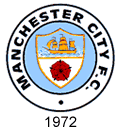 In October 1970 a circular crest, which had been used on stationary throughout the previous decade, appeared on the team's shirts for the first time. The central shield, which was derived from the city coat of arms was replaced in 1972 by a new version with a Lancashire rose instead of the three diagonal stripes of the original.
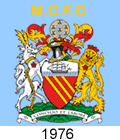 Between 1976 and 1981 the Manchester coat of arms was used before the 1972 crest was reinstated.
The 1980s brought relegation twice (1983, 1987)
and promotion twice (1985, 1989) and  a return to the inconsistencies of
the past.
a return to the inconsistencies of
the past.
The club celebrated its centenary in 1994-95 and a special crest was created by the owner of the souvenir shop, Eddie Phillips. This appeared on products in the shop but was not adopted for the team's shirts
In 1994 former player, Francis Lee took control of the club
from Peter Swales but what started out as a new era of optimism turned
into disaster. Having 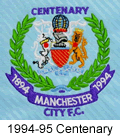 invested heavily in the transfer market and in building
the new £11m Kippax Stand, City were relegated from the Premier
League to Nationwide Division One. Manager Alan Ball resigned and was
replaced by Steve Coppell who also resigned after 32 days in the job.
The club was in total disarray with accusations flying between the
invested heavily in the transfer market and in building
the new £11m Kippax Stand, City were relegated from the Premier
League to Nationwide Division One. Manager Alan Ball resigned and was
replaced by Steve Coppell who also resigned after 32 days in the job.
The club was in total disarray with accusations flying between the 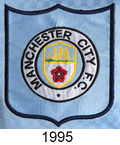 board,
players, management and fans. In 1998, Francis Lee bowed to pressure and
resigned to make way for a new board but despite a host of new signings
by manager Joe Royle, City were relegated to Nationwide Division Two,
the equivalent of the old Third Division.
board,
players, management and fans. In 1998, Francis Lee bowed to pressure and
resigned to make way for a new board but despite a host of new signings
by manager Joe Royle, City were relegated to Nationwide Division Two,
the equivalent of the old Third Division.
Because both versions of City's crest were based on the Manchester coat of arms it was not possible for the club to register copyright nor exploit image rights. To get round this 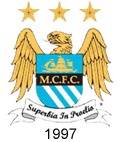 problem a new crest was commissioned in 1997. The golden eagle featured in the city's coat of arms in the late 1950s (Manchester United wore an eagle crest in the 1958 FA Cup final). The ship is a reference to the Manchester Ship Canal while the three stripes represent Manchester's three rivers. The Latin motto Superbia in Proelio translates as "Pride in Battle." The stars are purely decorative. Variants that have appeared over the years include various background shields and, on the 2012-13 strip, a monochrome version.
City were expected to take the Division by storm in 1998-99 but their campaign proved a struggle and in the end they sneaked into the play-offs, meeting Gillingham at Wembley for a place in Nationwide Division One. City fell two goals behind but snatched an equaliser in the fourth minute of extra time before winning the match in a penalty shoot-out. The following season, City won automatic promotion on the last day of the season and returned to the Premiership wearing what the manufacturers described as "lazer blue" shirts. A year later, City were relegated yet again and Royle was sacked, the ninth management casualty in ten years.
 Former England boss, Kevin Keegan was appointed
manager. An inspirational leader who had been found wanting as a tactician
in his previous job, Keegan led the Blues back to the Premiership with
two games to spare in 2002. The following season, City finished in ninth
place and finally left Maine Road, their home since 1922, to move into
the brand new City of Manchester Stadium.
Former England boss, Kevin Keegan was appointed
manager. An inspirational leader who had been found wanting as a tactician
in his previous job, Keegan led the Blues back to the Premiership with
two games to spare in 2002. The following season, City finished in ninth
place and finally left Maine Road, their home since 1922, to move into
the brand new City of Manchester Stadium.
In 2007 the majority shareholding in Manchester City was acquired by UK Sports Investments Ltd, a company controlled by the former Prime Minister of Thailand, Thaksin Shinawatra. Upon achieving a 75% share, Thaksin re-registered the club as a private company; on later acquiring 90% of shares Thaksin bought out the remaining shareholders to become the sole owner of the club. When his assets were frozen by the Thai courts, pursuing charges of corruption against Thaksin and his wife, he was forced to sell the club to a consortium based in the United Arab Emirates, the Abu Dhabi United Group, in September 2008. They signaled their immediate intention to inject substantial funds into the club's transfer budget in order to attract world class players to the City of Manchester Stadium.
The injection of Arab cash allowed manager Roberto Mancini to build a side that finished in fourth place in 2010-11, qualifying for the Champions' League and won the FA Cup, beating Stoke 1-0, their first major trophy for 35 years. The naming rights to the club's stadium were sold to Etihad Airways in a deal reported to be worth over £10m a year for ten years: this is in addition to the £2.3m shirt sponsorship contract and led 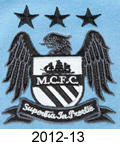 to suggestions that the club was attempting to evade the new UEFA Fair Play financial regulations.
In the final match of 2011-12, City needed to win to secure the Premier League title. Trailing at home to Queen's Park Rangers with 90 minutes gone, they scored twice in added time to pip Manchester United for the title, their first in 44 years.
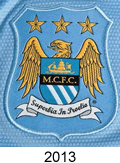 The following season, City finished as runners up in the Premier League and were surprisingly beaten by Wigan Athletic in the FA Cup final. Shortly afterwards, while on tour in the United States, the club's owners announced that they had entered into a partnership with the New York Yankees to buy the MLS franchise for a second soccer team in New York City.
At the end of the 2013-14 season, now managed by Manuel Pellegrini, City overtook Liverpool to clinch another title. They were, however, found to have breached UEFA's Financial Fair Play regulations, which had now come into effect and were forced to agree to a complex set of sanctions that 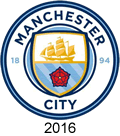 included a conditional £49m fine, a reduction in the number of players in their squad for European competition, a wage cap and restrictions on incoming transfers.
For the 2016-17 season the club introduced a redesigned crest, an updated version of the very popular circular badge worn in the 1970s. The three central symbols, chosen by supporters with tradition in mind, comprise a sailing ship (symbolising Manchester's history as a trading city), three diagonal stripes (representing the rivers Irwell, Medlock and Irk that flow through the city) and the red rose of Lancashire.
Under the leadership of Pep Guardiola, appointed manager on 1 February 2016, the team made steady progress thanks both to the deep pockets of their backers and Guardiola's ability to bring out the best in his players. In 2017-18 they ran away with the Premier League title, establishing eleven new records including points earned (100), matches won (32) and most goals (106).
City now stood at the apex of the City Football Group, a global enterprise established in 2013-14 to manage the interests of the Abu Dhabi United Group. The group owns stakes in Melbourne City FC, Yokohama F Marinos (Japan), New York City FC, Club Atletico Torque (Uruguay) and Girona FC. The purpose of the group is to share resources, academy networking, marketing and create pathways for developing talent across the world.
The 2018-19 season brought City an unprecedented domestic treble as well as the Community Shield. However, a UEFA investigation into allegations that they had breached the Fair Play Rules. It was alleged, on the basis of leaked emails published by Der Spiegel, that City had "overstated its sponsorship revenue in its accounts and in the break-even information submitted to EUFA between 2012 and 2016," with the bulk of the funds being provided by the owner, Sheikh Mansour. Furthermore the club had deliberately obstructed the investigation. In February 2020 the independent Adjudicatory Chamber of UEFA's Club Financial Control Body banned City from European competition for two seasons and fined £26.9 million. The ruling was later overturned by the Court of Arbitration for Sport (CAS) but their findings fell short of exonerating the club, stating in the judgement that "most of the alleged breaches....were either not established or time barred," (emphasis added). The CAS agreed that the club had failed to cooperate with the original investigation without questioning why they would have done so and reduced their fine to £9 million.
The 2020-21 season brought another Premier League title to the club along with the EFL Cup but they lost to Chelsea 1-0 in the Champions League final.
In January 2022 City were 13 points ahead of Liverpool and seemed to have the title sewn up. Liverpool then won ten games on the trot and on the final day of the season they were just one point behind. With 15 minutes to go, City were trailing 2-0 to Aston Villa while Liverpool were winning 3-1 against Wolves. It looked like the title was going to Merseyside but in a remarkable five minute blitz, City scored three times to secure their fourth championship in six years.
The controversy over City's finances rumbled on and in April 2022 Der Spiegel published further allegations, based on leaked internal documents, of illicit and disguised payments. The club dismissed these claims as untrue and an attempt to smear City's reputation.
The strip introduced for 2022-23 was intended as a tribute to the great City sides of the 1960s and early 70s and was dedicated to Colin Bell, one of the most talented player ever to have represented the club. In that season City won the UEFA Champions League for the first time as well as the Premier League and FA Cup. Another Premier League title followed in 2023-24.
Sources
- (a) Gary James - MCFC official historian
- (b) empics
- (c) The West Ham United Collection (2003)
- (d) Sporting Heroes
- (e) Manchester City Official Website
- (f) Football Focus
- (g) Bury FC - Images of Sport (Peter Cullen 1998)
- (h) True Colours (John Devlin 2005)
- (i) The Official Manchester City Hall of Fame (Gary James 2006)
- (j) Association of Football Statisticians - provided by Pete Wyatt
- (k) Bjørn-Terje Nilssen
- (k) Pete's Picture Palace
- (l) Football League Review provided by Simon Monks
- (m) Alick Milne
- (n) Simon Monks
- (o) Eamonn Monks
- (p) Kjell Hanssen
- (q) Keith Ellis
- (r) Alex Howells
- (*) Beastly Fury (Richard Sanders, Bantam Press 2009)
- (s) Simon Monks
- (t) Phil Bannerjee
- (u) Anthony Sealey
- (v) Oleg Baranov
- (w) Pavel Shalaev
- (x) Nigel Dowthwaite
- (y) Athletic News (23 October 1893) submitted by Kingsley (Wrexham AFC)
- (z) Dr Gary James
- (A) Lost Teams of the North (Mike Bradbury2016)
- (B) 101 Manchester City Shirts (Mark McCarthy 2021) submitted by Tony Sealey
- (C) Tony Sealey
* Kit graphic by Daniel Stoker
Crests are the property of Manchester City FC.