




AFC
Bournemouth
Formed 1899
Elected to Division Three (South) 1923
Kit History
Boscombe
1899

1899-1900 a

1900-1915 a

1915-1919

1919-1920 z

1921-1922 a
Bournemouth & Boscombe Athletic
1923

1923-1925 k

1925-1926 k

1926-1927 a
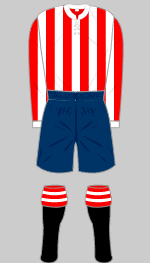
1928-1929 o

1930-1931 a

1931-1932 a

1932-1936 a e p
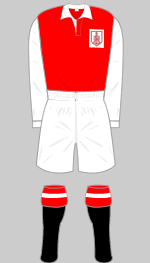
1936-1949 a k


1949-1950 a

1953-1954 a
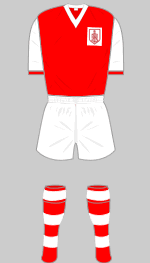
1956-1959 a p y

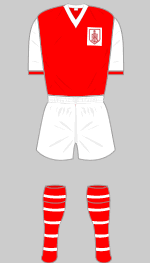
1960-1961 p

1961-1963 a

1962-1963 2 f

1963-1964 f
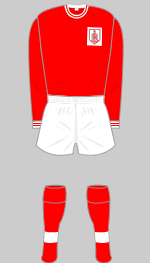
1964-1966 f y

1966-1967 i
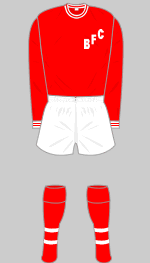
1968-1969 a r

1969-1970 f
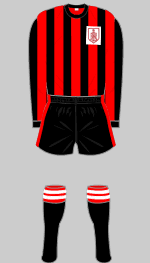
1970-1971 a

1971-1972 a
AFC Bournemouth
1972

1972-1973 a

1973-1974 f

1974-1975 a
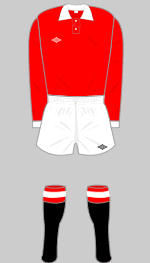
1975-1977 j n

1977-1978 n

1978-1979 f

1979-1980 g

1980-1981 f g

1981-1982 f g

1981-1982 f m

1982-1983 b f v

1983-1985 f g
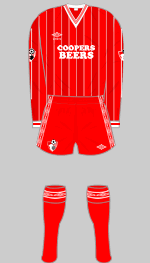
1985-1986 f g

1986-1987 a f m r t

1987-1988 f m r u

1988-1989 a f t

1989-1990 f

1990-1992 a s
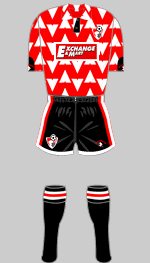
1992-1993 a f t w

1993-1994 l t

1994-1995 j l t

1995-1996 c

1996-1997 c t

1997-1998 c t

1998-2000 c t u

2000-2001 c q t
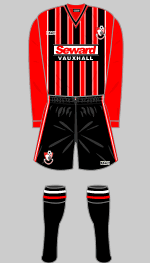
2001-2002 u

2002-2003 c t

2003-2004 c
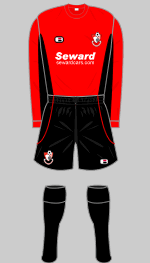
2004-2006 a
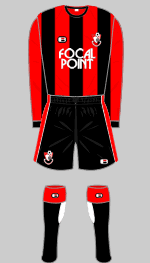
2006-2008 h
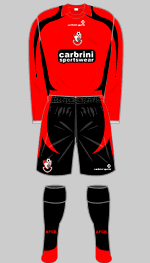
2008-2010 h
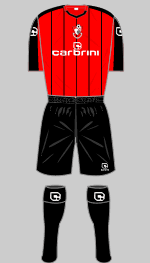
2010-2011 h
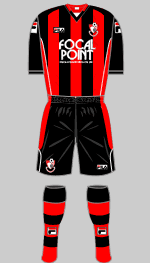
2011-2012 h
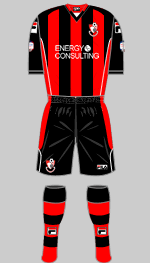
2012-2013 h
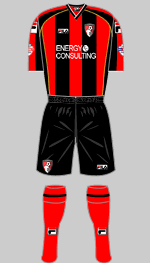
2013-2014 h
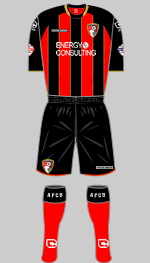
2014-2015 h
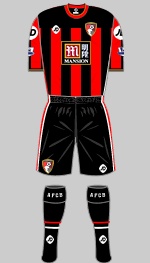
2015-2016 h
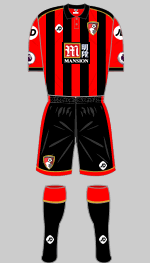
2016-2017 h
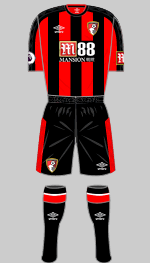
2017-2018 h
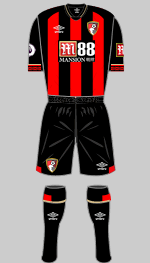
2018-2019 h
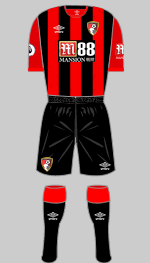
2019-2020 h
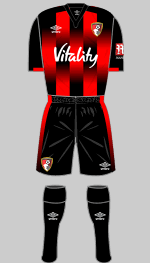
June-July 2020 h
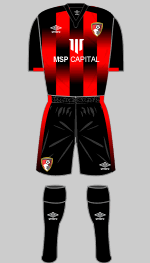
Sept 2020-2021
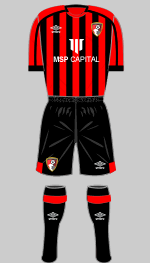
2021-2022 h
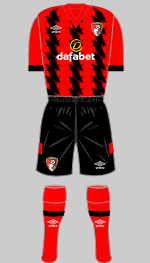
2022-2023 h

2023-2024 * h
Background
 Bournemouth trace their roots
back to 1890 and the formation of Boscombe St Johns Institute FC. When
this club was wound up in 1899, several members, meeting under a gas lamp
in Gladstone Road, agreed to form Boscombe FC. The new club played in
the Bournemouth & District Junior League but rose to sufficient prominence
that around the turn of the century they joined the Hampshire League.
In 1910 Mr JE Cooper-Dean granted the club a long lease on some waste
ground which was developed into the club's home, named Dean Court, after
their benefactor. The club nickname of "The Cherries" dates
from this period and is supposed to be a reference to the nearby fruit
orchards on the Cooper-Dean estate. A rather less romantic version links
the name to the cherry-red and white striped shirts the club wore.
Bournemouth trace their roots
back to 1890 and the formation of Boscombe St Johns Institute FC. When
this club was wound up in 1899, several members, meeting under a gas lamp
in Gladstone Road, agreed to form Boscombe FC. The new club played in
the Bournemouth & District Junior League but rose to sufficient prominence
that around the turn of the century they joined the Hampshire League.
In 1910 Mr JE Cooper-Dean granted the club a long lease on some waste
ground which was developed into the club's home, named Dean Court, after
their benefactor. The club nickname of "The Cherries" dates
from this period and is supposed to be a reference to the nearby fruit
orchards on the Cooper-Dean estate. A rather less romantic version links
the name to the cherry-red and white striped shirts the club wore.
The club was ambitious and when the Football League formed a Third Division comprising the Southern League First Division clubs, Boscombe successfully applied to join the rump Southern League. Three years later, Boscombe successfully applied to join the League. To mark the occasion (and to attract wider support locally), the club changed its name to Bournemouth & Boscombe Athletic, the longest name in League history.
 The Cherries were to remain in the Third Division
(South) until 1958 when they became founder members of the new (national)
Third Division, where they remained until they were relegated in 1970.
In the mid Thirties the club adopted Arsenal style
shirts adorned with a crest derived from the arms of the twin towns of Bournemouth and Boscombe but the new image failed to create an impact on the pitch. The crest made several appearances right up until 1974-75.
The Cherries were to remain in the Third Division
(South) until 1958 when they became founder members of the new (national)
Third Division, where they remained until they were relegated in 1970.
In the mid Thirties the club adopted Arsenal style
shirts adorned with a crest derived from the arms of the twin towns of Bournemouth and Boscombe but the new image failed to create an impact on the pitch. The crest made several appearances right up until 1974-75.
In 1956-57, the club enjoyed a moment of national
prominence by beating First Division Wolves and Spurs in the FA Cup before
they were defeated by two controversial goals by 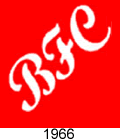 Manchester United in
the quarter-final.
Manchester United in
the quarter-final.
In the late Sixties initials became more fashionable than crests and Bournemouth's shirts were emblazoned with "BFC" in various, unusual formats. It is interesting to note that the rather cumbersome initials of the club, B&BFC, were not used, presaging the change of name that would come in 1972. The 1936 crest made a final appearance in 1970-71.
In 1971, Bournemouth were relegated to the Fourth
Division for the first time but bounced back immediately with manager
John Bond and sensational striker Ted MacDougall setting the division
alight. Bond had earlier introduced 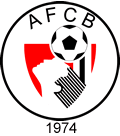 a smart new black and red strip, modeled on AC Milan, and
in 1972 the club adopted the rather stylish title of AFC Bournemouth.
After narrowly missing out on promotion to the Second Division, both Bond
and MacDougall left for greater things and in 1975 the club were back
in the Fourth Division.
a smart new black and red strip, modeled on AC Milan, and
in 1972 the club adopted the rather stylish title of AFC Bournemouth.
After narrowly missing out on promotion to the Second Division, both Bond
and MacDougall left for greater things and in 1975 the club were back
in the Fourth Division.
In the 1974-75 season the club wore a rather swish new badge on their striking red shirts, which had a bold white/black/white vertical stripe on the left, a detail repeated on 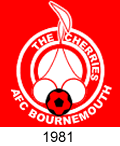 the crest. This was based on a new logo that had appeared on the club programmes after the rebranding of 1972 under the tag line, "Heading for the Top." Although it disappeared after one season the badge would re-emerge nine years later.
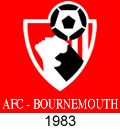
In 1981 a new badge was commissioned which played on the club's nickname, "The Cherries." This was dropped in 1983 in favour of the headed ball. This basic design served the club for over 30 years with a few minor modifications along the way. A detail of note is that the team's original red and white stripes were preserved in the 1983 badge.
 During the 1980s, under manager Harry Redknapp,
Bournemouth enjoyed their finest period to date. In January 1984 they beat
holders Manchester United in the FA Cup and in 1987 they won the Third
Division championship for the first time. There followed a dramatic three
During the 1980s, under manager Harry Redknapp,
Bournemouth enjoyed their finest period to date. In January 1984 they beat
holders Manchester United in the FA Cup and in 1987 they won the Third
Division championship for the first time. There followed a dramatic three  year spell
in the Second Division.
year spell
in the Second Division.
By the mid-Nineties, financial problems had reached
crisis point and the club went into receivership in 1997. With no rich
benefactor on the horizon the future looked bleak and at one stage the
club were 15 minutes away from closure. A successful bid from the Supporters
Trust meant that AFC Bournemouth survived and became the first community
owned professional club in Europe. In April 2001, the Cherries temporarily
moved in with Dorchester FC while their Dean  Court stadium was rebuilt.
Work was completed in November 2001 but the season was to end in relegation
to Nationwide Division Three. Happily they were promoted via the play-offs
the following season.
Court stadium was rebuilt.
Work was completed in November 2001 but the season was to end in relegation
to Nationwide Division Three. Happily they were promoted via the play-offs
the following season.
In 2008-09 the Cherries narrowly avoided relegation to the Conference before being  promoted the folowing season, the start of an astonishing rise through the divisions. In 2013, on an exciting final day, Bournemouth finished as runners up in League One, a point behind Doncaster and returned to the second tier. For the following season a revised crest was introduced with the club's name picked out in gold, a theme picked up in the new strip. The old red and white striped motif was now consigned to history.
The 2014-15 season was the most successful in the club's history and ended with The Cherries winning the Championship title and promotion to the Premier League although this was achieved by overspending in breach of Financial Fair Play Rules. A fine of £7.6 million was later reduced to £4.75 million. Against all expectations Bournemouth retained their place in the top tier until they were relegated on the final day of the extended 2019-20 season. After the disappointment of losing out in the play-offs in 2021 the Cherries achieved automatic promotion the following season, finishing second behind Fulham.
Sources
- (*) Graphic by Daniel Stoker
- (a) www.afcb.premiumtv.co.uk
- (b) Southend United FC (Images of Sport)
- (c) empics
- (d) Football Focus
- (e) The Football Encyclopaedia (Associated Sporting Press 1934) Information provided by Arthur Fergus
- (f) Gavin Meaden
- (g) Independent Cherries Web Page.
- (h) AFCB Vital - unofficial site well worth a visit.
- (i) The Definitive AFCB (Leigh Edwards & John Treleven Published by Tony Brown, 2003) - information provided by Gavin Meaden
- (j) Dave Jennings
- (k) Association of Football Statisticians - provided by Pete Wyatt
- (l) David King
- (m) www.jumpers4goalposts.com
- (n) Alick Milne
- (o) British Pathe
- (p) Keith Ellis
- (q) Haz
- (r) Christopher Worrall
- (s) Rob Treweek
- (t) oldfootballshirts.com
- (u) Gareth Davies
- (v) Rutger Karssing
- (w) George Chilvers
- (x) seniortigers.org.uk
- (y) seniortigers.org.uk
- (z) Harry H
Crests are the property of AFC Bournemouth.